Why Doesn't Training Stick? Meet the Delta
By
Mike Martin
Every learning leader I know has asked some version of the same question, usually while staring at a program they were proud of and results that did not match. Why doesn't training stick?
We pour real budget, time, and talent into the event. The session lands. People are engaged. They write things down, make commitments, and walk out energized. And then, weeks later, almost nothing has changed. The energy faded. The habits snapped back. The expensive day became a memory.
After 25 years of building and leading learning, I have come to a conclusion that reframes the whole problem. Learning does not stick because people were exposed to it. Learning sticks when the right conditions are created around it. The exposure is the easy part. The conditions are where the work is, and where most programs quietly stop.
Most training stops at 60 percent of the job
Here is the pattern I see almost everywhere. We design the session. We deliver it. We facilitate a great experience. We check the box. And then we hand the rest back to the individual with no structure around it. That is the "good luck with that" moment, and it is where roughly 40 percent of the job goes undone.
It is not a people problem. It is not that your learners are lazy or your facilitators are weak. It is a design problem. We designed for the event and left the part where capability actually forms to chance.
The Delta: where change gets unlocked
So what are the conditions that actually make learning stick? I think about it as the Delta. The delta, the triangle, is the symbol for change. It gets unlocked when three forces show up at the same time, after the learning event ends.
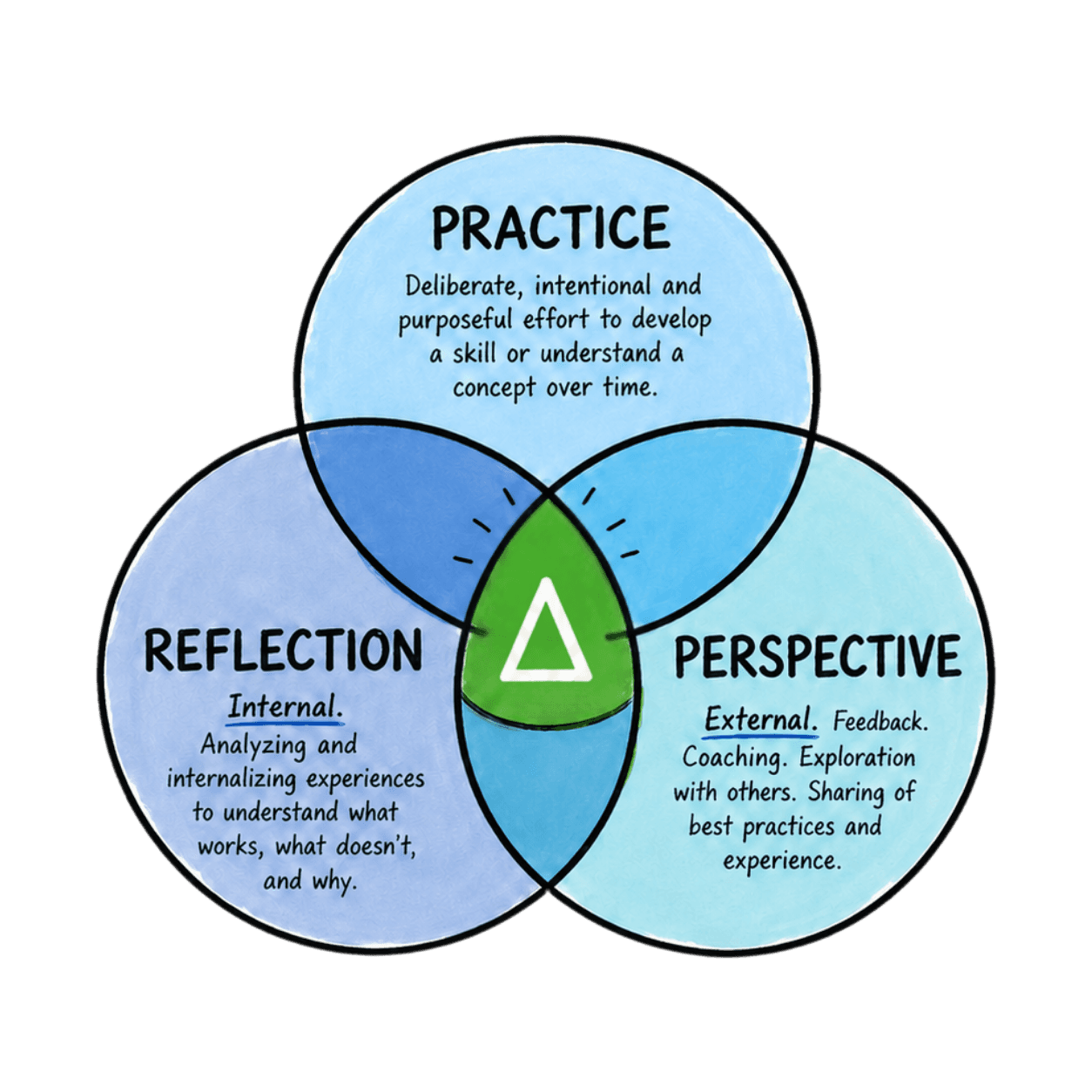
Practice. Deliberate, intentional, purposeful effort to develop a skill over time. Not doing it once in a workshop. Working at it, repeatedly, with intention, on the few things that matter most. Without practice, learning stays theoretical.
Reflection. The internal work of making sense of experience. Looking back at what happened, what worked, what did not, and why. This is a habit, not a one-time debrief exercise. Without reflection, practice becomes repetition without insight.
Perspective. I almost called this one feedback. But feedback makes most people picture a manager with a rubric, and that is too small. Perspective is any outside input that gives you a view you cannot generate alone. A book, a YouTube video, a workshop, a peer who says the uncomfortable thing, or yes, a conversation with an AI. The form does not matter. The function does: get outside your own head. Without perspective, reflection stays trapped in your own blind spots.
And here is the thing: you need all three. Practice without perspective is just reinforcing your blind spots with more reps. Perspective without reflection is noise you never slow down to process. Reflection without practice is great intentions that never leave your journal. Two out of three gets you closer, but it does not get you there. The delta only opens when all three show up at the same time.
This is the key distinction. And the one most programs miss
None of these are things that typically happen during a session. They are what the learner, and the organization, build into the weeks and months after the session ends. The delta is not unlocked in the room. It is unlocked in the real world, after everyone goes back to work.
When all three forces overlap, the conditions for meaningful change exist. The visible shift happens in how someone thinks, acts, leads, decides, or performs. That is the ballgame.
You cannot force change. You can build the conditions for it
This is the line I keep coming back to. You cannot force change. But you can build the conditions for it. Practice, reflection, and perspective are those conditions. The question for any learning leader is not "was the event good?" The event was probably fine. The question is whether anything exists to carry practice, reflection, and perspective into the days that follow.
For most organizations, the honest answer is no. The LMS was not built for it. The calendar does not protect it. And managers, however well-meaning, rarely have the structure, prompts, or timing to do it consistently.
This is exactly what Praxis was built to do
Praxis is the layer that delivers the Delta after the event ends. A Praxis journey takes a workshop, offsite, kickoff, or leadership program and extends it into a structured path of spaced practice, guided reflection, and real perspective from a cohort. Practice prompts bring the key ideas back at the right moment. Reflection moments turn experience into insight. Cohort chat and coaching supply the outside perspective that breaks the blind spots. The LMS stores and tracks your content. Praxis creates the follow-through that makes it stick.
Training's end does not have to be learning's end. Build the conditions, unlock the delta, and the change you were after finally has somewhere to take root.
Want to see what the Delta looks like applied to one of your programs? Let's talk.